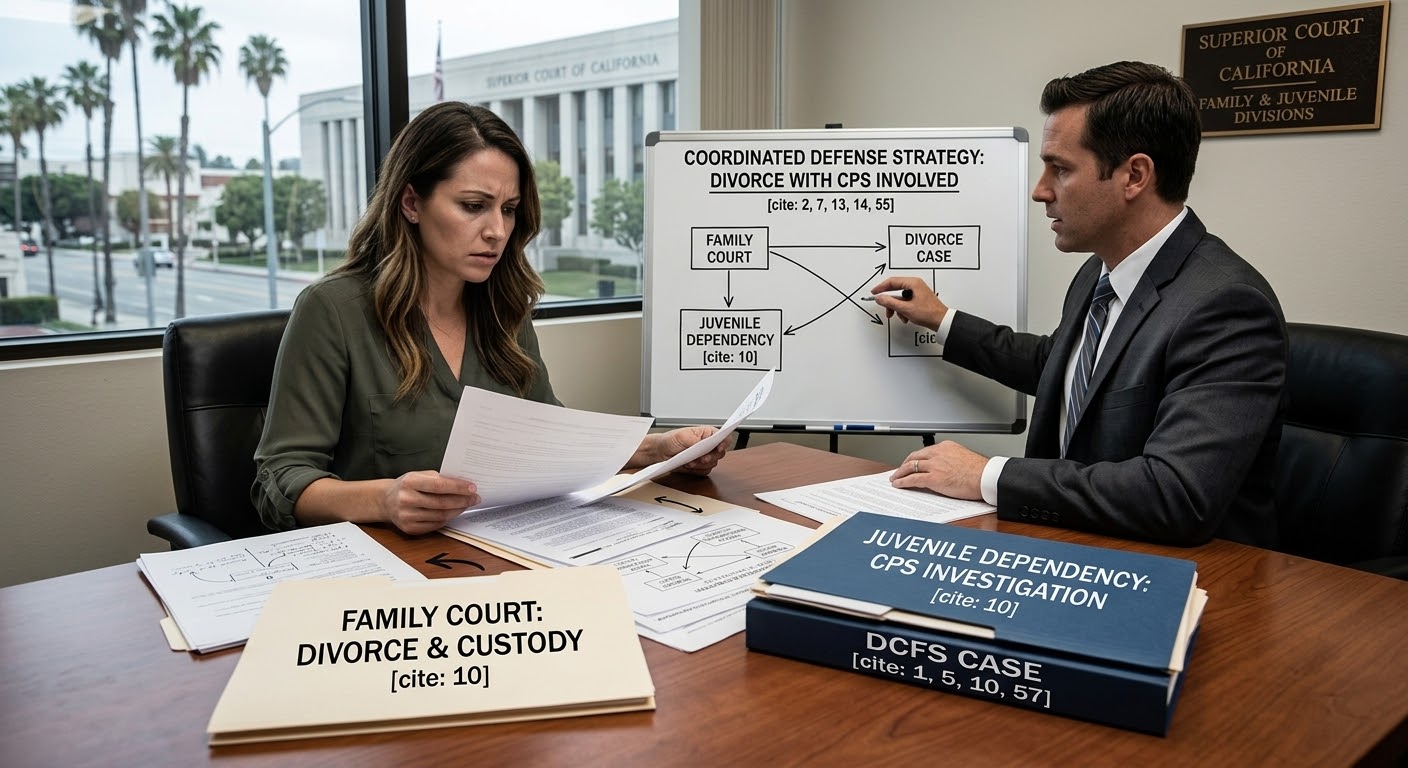
Going through a divorce is already one of the most stressful experiences a family can face. When a CPS or DCFS investigation is happening at the same time, the legal complexity multiplies — and so do the stakes. This guide explains how the two legal systems interact, what each means for your case, and why handling both requires a very specific kind of attorney.
If You Are Facing Both a Divorce and a CPS Case Simultaneously You are navigating two separate court systems that can issue conflicting orders about your children. Most attorneys handle one or the other — not both. Family First Attorneys handles juvenile dependency AND family law — under one roof. Call 323-STOP-CPS for a free consultation. Available 24/7.
Two Courts, Two Cases — One Family
When CPS becomes involved while a divorce or custody dispute is in progress, you are simultaneously dealing with two completely separate court systems that both have authority over your children. Understanding how they differ — and how they interact — is the first step to protecting yourself and your family.
Purpose — Handles divorce, property division, custody, and support between parents — Handles the state’s case involving child safety, CPS investigations, and parental rights
Who files the case — One parent files a petition against the other — The county (CPS/DCFS) files a petition against the parent(s)
Who decides custody — A family court judge applies the “best interest of the child” standard — A dependency court judge makes orders to protect the child’s safety first
Which court wins if orders conflict — Dependency court orders override family court orders on custody matters — Dependency court has jurisdiction priority when a child is a dependent of the court
Can you resolve without going to court — Yes — through mediation, settlement agreements, or stipulated orders — Partially — some aspects can be resolved with CPS, but the court retains oversight
Attorney you need — Family law attorney — Juvenile dependency attorney (a specialized subset of family law)
The most critical fact in the table above: when both courts have issued orders about your children and those orders conflict, the Juvenile Dependency Court order generally takes precedence. This means that even if you have a favorable family court custody order, a dependency court can restrict or modify your custody rights based on the CPS case.
This is why parents in this situation cannot afford to have one attorney handling the divorce while ignoring the dependency case, or vice versa. Both cases must be managed together with a unified legal strategy.
How a CPS Case Can Affect Your Divorce
A CPS investigation or dependency case does not happen in isolation. Its findings, orders, and outcomes ripple directly into your divorce and custody proceedings in several important ways.
1. Custody Decisions Are Directly Impacted
In a California divorce, custody is determined based on the “best interest of the child” standard. A pending CPS investigation or active dependency case is directly relevant to that determination. A family court judge will consider:
- Whether CPS has substantiated any allegations of abuse or neglect against either parent
- Whether either parent has a history of domestic violence — which creates a presumption against custody under Family Code § 3044
- Whether either parent is subject to a safety plan, court-ordered services, or supervised visitation in the dependency case
- Whether the child has been removed from the home and placed in a dependency case
A finding by the dependency court that a parent abused or neglected their child will carry enormous weight in the family court custody determination. Conversely, a dependency case that is closed or dismissed with a finding in the parent’s favor can also be powerful evidence in the divorce proceeding.
2. The Other Parent May Use the CPS Case Against You
In contentious divorces, one parent sometimes reports the other to CPS as a tactical move — hoping that a CPS investigation will give them an advantage in the custody dispute. California courts are increasingly aware of this pattern and take a dim view of parents who make knowingly false reports.
Under California Family Code § 3027.1, if a court finds that a parent made false allegations of child abuse or neglect to gain an advantage in a custody proceeding, the court may impose sanctions, award attorney’s fees to the other party, or even modify custody in favor of the falsely accused parent.
If you believe your spouse has made a false CPS report against you as part of a divorce strategy, document everything and tell your attorney immediately. The response to a false allegation is time-sensitive and requires a carefully coordinated approach across both courts.
3. Restraining Orders and Protective Orders
Divorces involving domestic violence often include both a family court restraining order (Domestic Violence Restraining Order, or DVRO) and potential CPS involvement. These two legal actions are interconnected in important ways.
A DVRO can affect custody directly — California law creates a rebuttable presumption that it is not in the best interest of the child to award custody to a parent who has committed domestic violence. At the same time, a CPS case involving domestic violence can impact the terms of the DVRO and vice versa.
If domestic violence is part of your situation — whether you are the protected party or the restrained party — you need an attorney who understands how all three pieces (the divorce, the dependency case, and the restraining order) interact with each other.
How Your Divorce Can Affect the CPS Case
The relationship between the two cases runs in both directions. Just as the CPS case affects your divorce, the divorce proceedings can also impact the CPS case.
Conflicting Testimony and Evidence
In both proceedings, you will be asked questions about your parenting, your relationship with your children, and the circumstances in your home. What you say in one court can and will be used in the other. A statement made in a family court deposition that contradicts your account in dependency court can be used to undermine your credibility across both cases.
This is one of the most dangerous traps parents in dual proceedings fall into. Without coordinated legal representation, it is easy to inadvertently create inconsistencies in your testimony that hurt you in both courts simultaneously.
Service Plans and Divorce Agreements
If the dependency court has ordered you to complete a case plan — including services like parenting classes, counseling, drug testing, or domestic violence programs — those requirements will likely be referenced in your divorce proceedings. Completing them promptly and thoroughly is not just important for the CPS case. It demonstrates to the family court that you are taking your responsibilities as a parent seriously.
Some divorce agreements also attempt to incorporate elements of a dependency case plan. This requires careful legal drafting to ensure that the agreements are compatible across both courts and do not inadvertently create problems in either proceeding.
The Six Biggest Mistakes Parents Make in This Situation
After representing hundreds of families navigating both divorce and CPS cases, experienced dependency attorneys see the same costly mistakes over and over. Avoid these:
- Hiring separate attorneys who don’t communicate with each other. Your family law attorney needs to know what is happening in dependency court and vice versa. Siloed representation creates dangerous gaps in your defense.
- Talking to CPS without legal guidance during divorce proceedings. What you say to a social worker can be used against you in your divorce — not just in the dependency case.
- Signing documents in one case without understanding the impact on the other. A settlement agreement in your divorce could inadvertently waive rights or create conflicts with a dependency court order.
- Using the CPS case as a weapon in the divorce. Courts in both systems are experienced at identifying parental manipulation and will hold it against you. Focus on your children’s wellbeing, not on winning.
- Missing hearings in either court. With two parallel proceedings, scheduling conflicts are common. Missing even one hearing signals to the court that you are not engaged and can result in adverse orders being entered without your input.
- Failing to complete service plan requirements because you are distracted by the divorce. Compliance with your case plan in dependency court directly affects the custody outcome in your divorce. Both must be prioritized simultaneously.
What to Do If You Are in This Situation Right Now
If you are currently dealing with both a divorce or custody dispute and a CPS or DCFS case, the most important step you can take is to get coordinated legal representation immediately. Here is what that process looks like with Family First Attorneys:
How Family First Attorneys Handles Dual Proceedings Step 1: We review both your family court matter and your dependency case together in a single consultation. Step 2: We develop a unified strategy that protects your interests in both courts simultaneously. Step 3: We coordinate all court appearances, filings, and communications to ensure consistency across both proceedings. Step 4: We keep you informed about how developments in one case affect the other — so nothing catches you off guard. Step 5: We fight for the outcome that matters most: keeping your family together and your parental rights intact.
Why This Case Requires a Specialist — Not a Generalist
Most family law attorneys handle divorce, custody, and support. Most dependency attorneys handle CPS cases. Very few handle both — and even fewer do so under one roof with a unified strategy.
When a parent hires a divorce attorney who is unfamiliar with dependency court, that attorney may inadvertently create problems in the CPS case. When a parent hires a dependency attorney who does not understand divorce strategy, the family court proceeding may suffer. Hiring two attorneys who work in separate silos is better than having no representation — but it still leaves gaps.
Family First Attorneys was built specifically to serve families in exactly this situation. Attorney Mitchell Krems’ practice spans both juvenile dependency law and family law, which means your entire legal situation is managed by a team that understands how both systems work and how they interact with each other.
If you are facing both a divorce and a CPS case — or if you are worried that a CPS case may be coming — the time to get coordinated legal representation is now. Not after the next hearing. Not after you have already made statements to a social worker. Now.
One Call. Both Cases. Zero Gaps. Family First Attorneys handles DCFS defense, child custody, divorce, and restraining orders. Call 323-STOP-CPS for a free consultation — available 24 hours a day, 7 days a week. Serving Orange County, Los Angeles County, Riverside County, and San Bernardino County. Se habla español.
- Can a Restraining Order Affect My Divorce Case in California?
- How to File for Divorce in Orange County: A Step-by-Step Guide
This article is for informational purposes only and does not constitute legal advice. No attorney-client relationship is formed by reading this content. California family law and juvenile dependency law are complex areas that interact in case-specific ways. Please consult a qualified California attorney regarding your specific situation.
Protect Your Family — Call Now
Family First Attorneys provides 24/7 emergency consultations and aggressive defense for parents across Los Angeles, Orange, Riverside, and San Bernardino Counties.
Call 323-STOP-CPS — Free ConsultationThis article is for informational purposes only and does not constitute legal advice. No attorney-client relationship is formed by reading this content. Every CPS and DCFS case is unique and the outcome depends on the specific facts and circumstances involved. Please consult a qualified California family law attorney regarding your specific situation.